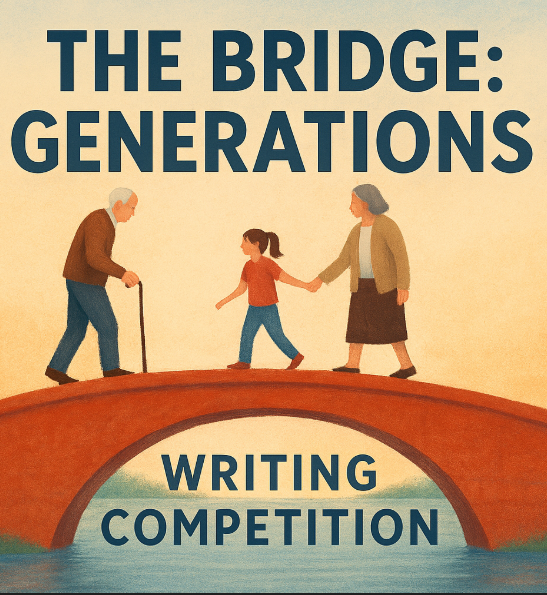
The Bridge, Generations: Senior Prizewinners 2026
Bailey Wong, 3rd place
The kitchen seemed to be the only part glowing in the house, there are steam clouded on the window, blurring out the twilight outside. Her mother stood by the stove, stirring the hot pan with slow, steady circles, as the air smelled of herbs and onions – she smelled the exact scent she remembers in her little known youth. The dull, overused, ‘golden’ doorknob turns slowly, as the door screeches: ‘what are you making, momma?’ A little girl around six, seven appeared behind the door. She wrinkled her nose.
‘Chicken stew,’ her mother said, without turning. ‘It was my mother’s recipe. She used to make it every Sunday.’
She raised an eyebrow. ‘We still do that? You know no one actually eats it?’
Her mother chuckled quietly. ‘It’s not always about eating it.’ There was a long pause.
Then the room filled with a gentle hiss of the broth. She watched her mother like it was something sacred. Something about that quiet care made her uneasy. She slid closer, curiosity tugging at her in spite of herself. The mixture bubbled—a honeyed gold that caught the kitchen light like sunlight in water. Without thinking, she took the spoon from her mother’s hand.
‘It’s thicker than I thought,’ she muttered, stirring awkwardly.
A faint smile looking down at the young daughter, ‘You’ll get used to it. Every generation does.’ Then a warmth from the stove brushed against the girl’s face. For a brief moment, she thought of the same kitchen years ago: the same smells, the same sounds of a spoon in a pot, and a woman humming an old song in a language she didn’t know.
‘She would’ve liked you,’ her mother said softly.
‘Maybe,’ she said. ‘I would like her too.’ The mother and daughter sat together at the bumpy, wooden table, with a small bowl of chicken stew. It was salty, and a bit too thick, but they didn’t mind. Outside of the warm house, the cold wind pressed against the window as a force attempting to push in. The daughter stares at the window whilst eating. She felt lighter after having a spoon.
Perhaps she couldn’t explain the reason why – she felt the distance between her and her unfamiliar family shortened.
‘Maybe we should keep the recipe exactly same. Ma?’
Clara Fox, 2nd place
My granny says she used to lie on her back and watch the sky bleed from blue to amber,
she used to surf real waves that lifted and let her fall,
she used to trace animals in the slow drift of clouds.
I tell her the sky is an algorithm now.
I watch its pixels change colour on a glass horizon.
I say I surf too,
not tides, but tabs.
I ride the endless pull of links,
searching for answers to questions
too big for a search bar.
I keep my memories in the cloud,
stacked in folders instead of constellations.
I gaze at pictures and videos,
bright as bottled stars,
instead of galaxies that never needed charging.
She watched the world expand above her.
I watch it refresh.
Between us there is a river of static.
On her bank, letters written in looping cursive ink,
written with care and precision.
On my bank, disappearing messages,
and confessions typed with anxious thumbs.
On her bank are stories that light up the world and are absorbed into everyone around her,
making them light up and glow.
On my bank, the screen glows with cryptic code I cannot comprehend.
But somehow,
when I step into my Granny’s house
and breathe in that warm, biscuit-sweet air of childhood,
something in me powers down.
I learn things there.
We trade stories like treasures,
lean over half-finished jigsaws,
thread quiet concentration through the eye of a needle.
In her kitchen, screens lose their signal and time stops.
We are not old world or new world
We are not vintage and modern,
just two hands in the same puzzle.
After all, it isn’t the kind of sky we grew up under,
or the waves we did or didn’t ride,
or even the clouds that keep our memories safe
that bind us.
It’s the small, stubborn hope we share.
It is the choice to sit close,
It is the choice to listen,
It is the choice to make something together, that will not need charging to survive.
Estelle Lewis, 1st place – The Banyan Tree
‘For 1,000 years this tree has stood,’ Nani whispers. ‘It is as much our home as this house.’
Her voice is hoarse, hushed, her eyes clouded with a milky film. Age has wearied her, but her
stare is sharply focused on the tree visible from the balcony. It shivers under the stifling heat;
its canopy droops and weeps, but its roots ground themselves firmly in the hardening soil.
Ficus benghalensis. The Indian banyan.
I have played amongst its boughs since I could walk. Shaded from the scorching sun under
its leaves. I have danced around its trunk in the monsoon rain. Its tales have been sung and
spoken into my ear by the lull of my grandmother’s voice, often to quiet the incessant thrum
of Maa’s lavish parties: the banyan is the resting place of generations of my female ancestors.
The story goes that they can be seen dancing under the full moons of post-monsoon season.
‘They will invite you when it is time,’ Nani would vow as I sank into reverie, her cool
palm cupping my cheek. The mornings after, I would slip past the slumping masses on the
embroidered sofas and search the banyan for the women. They were never there and I learnt
that Nani’s tales were just that – tales. She repeats them now. I try to hush her – she must rest
her voice, as the doctor insisted – but she is not the type of woman to be silenced.
‘My mother is there in her finest saree. My grandmother, and her mother too.’ She smiles
softly as she speaks. ‘None of them are old or wrinkled with worry like I am, or they were
when they left. They are beautiful now.’
I stroke her hair. ‘You are beautiful too, Nani.’
She waves me away. A hacking shuddering cough envelops her. I try to drip water past her
cracked lips, but she resists, palming my cheek as she used to. I haven’t let her in years.
‘It is my time. You must accept that.’
I want to tell her not to be foolish. I want to apologise for my anger. It was never aimed at
you, Nani, I think, but it doesn’t matter. She is my mother’s mother, and hate is an insidious
poison. I do not speak but touch my hand gently to hers.
I sit for an hour as she slips into sleep. I think she is dreaming, for her lips curl upward as
she rests. I hope it feels sweet. I hope she sees the light of the moon set against the twilight.
Then, I realise that perhaps I am dreaming too, for suddenly she stands below the balcony,
shining brilliantly beneath the same moon. Her grey hair is an unfamiliar head of ebony curls,
her lined face smooth and pure – but it is her. Her and hundreds of glowing figures, women.
They are twirling, smiling, dancing around the thick leaves of the banyan tree, riding the cool
breeze to a place where time and logic are not welcome.
I have danced and laughed and cried under their tree. Nani’s tree. My tree. My grief will
sit there for a while, and I with it. But Nani was – and always has been – right. I will not sit
alone.











Post Comment
You must be logged in to post a comment.